


Public photo comparisons show a clear change in Antonio Conte’s hairline over time
with increased density and a lower frontal line compared to earlier images.
While there is no official public confirmation, the visible improvements strongly suggest he likely underwent a surgical procedure rather than relying on medication alone.
The Antonio Conte hair transplant analysis focuses on graft placement, hairline design, and growth patterns that match known surgical timelines.
Before and after images show restored coverage in previously thinning areas, consistent with modern FUE-based hair restoration. The sections below explain what can be confirmed, how such procedures work, and what factors influence these results.
Key Takeaways
- Public before and after photos suggest that Antonio Conte likely underwent a surgical hair restoration procedure, as the density and hairline changes are consistent with a modern FUE-based transplant rather than medication alone.
- Estimated graft counts for results like his typically range from 2,500 to 3,500 grafts, which is common for rebuilding the frontal third in men with male pattern baldness.
- The visible improvement in coverage during his time as Chelsea manager aligns with the standard growth timeline described in a hair transplant recovery timeline.
- When reviewing similar cases, readers should use the table of contents to focus on graft estimates, technique comparisons such as FUE versus FUT, and clinical factors that influence long-term donor safety and natural hairline design.
Did Antonio Conte Have a Hair Transplant?
Older photos show temple recession and thinning across balding areas. Later images, especially during his years in football management, show stronger density in the front. This pattern fits surgical hair restoration more than natural regrowth.
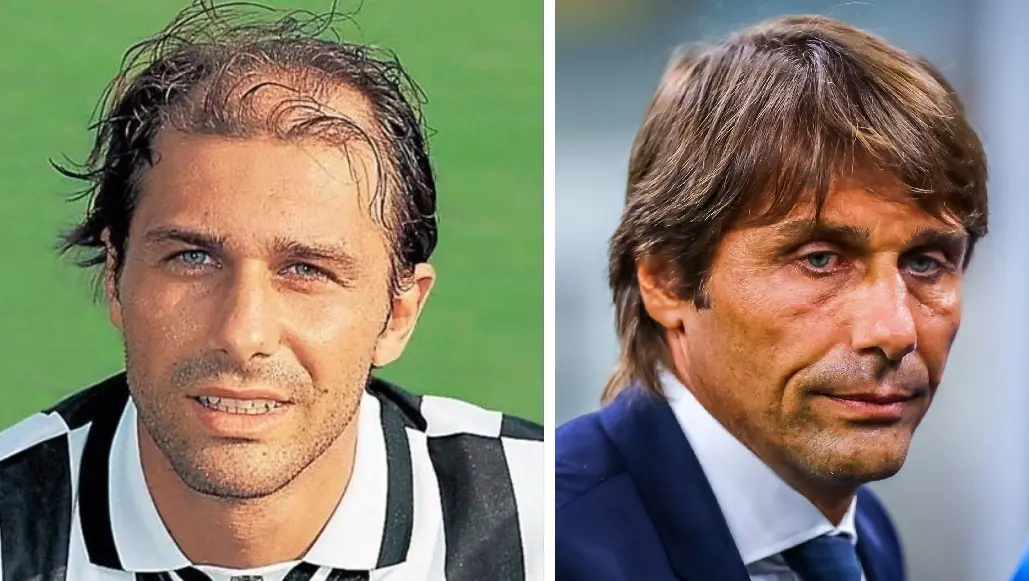
There is no official public statement confirming the clinic. Still, the change matches what doctors see after a FUE hair transplant procedure. Medication alone rarely lowers a hairline this much.
What We Can Confirm From Photos
Clear visible signs include:
- A lower frontal hairline
- Thicker coverage in former balding areas
- Even hair direction and angle
These changes suggest moved hair follicles rather than spontaneous regrowth.
Antonio Conte Before Hair Transplant
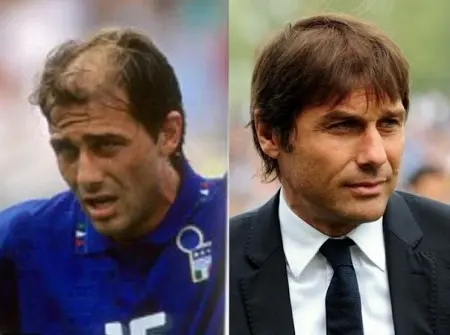
During his early years with the Italian national team, Conte’s hair loss showed a classic male pattern baldness pattern. The temples were thin, and the front looked recessed.
Patients with similar patterns often research when they should get a hair transplant to understand when surgery becomes predictable.
Estimated Graft Count
Doctors often estimate 2,500 to 3,500 grafts for this level of change. In clinical practice, that amount rebuilds the frontal third. It also protects the donor area from overharvesting.
Antonio Conte Hair Transplant Before and After
The Antonio Conte hair transplant before and after comparison shows more density and a clearer hairline shape. The front looks straighter and fuller.
Hair transplant surgery follows a known growth pattern:
- Weeks 2–4 – temporary shedding
- Months 3–4 – early regrowth
- Months 9–12 – fuller density
His public timeline matches this cycle.
Hairline Changes and Density
Modern hair transplant clinics focus on angle and spacing. When done correctly, results can leave no visible scars with short haircuts.
Timeline From Surgery to Results
Most final results appear after one year. This timeline fits typical regrowth phases described in hair transplant phases.
How Antonio Conte Grew His Hair Back
Hair transplant Antonio Conte analysis points toward surgery. A fue hair transplant moves single grafts from the donor area to thin spots.
Hair Transplant Antonio Conte: Likely Method
Two main options exist:
- FUE follicular unit extraction – removes single grafts
- FUT follicular unit transplantation – removes a strip of scalp
No visible strip scar suggests FUE over FUT.
FUE vs FUT Comparison
FUE removes individual grafts and avoids a long linear scar. FUT can provide many grafts at once but leaves a visible line in the donor zone.
In Greece, doctor-performed FUE often costs USD 3,500–6,000 for 2,500–3,000 grafts. This usually includes:
- The physician performing the full surgery
- Local anesthesia
- Choi pen implantation or DHI
- Structured follow-up visits
In Turkey, many clinics charge USD 1,800–2,800 for similar graft counts. Lower prices often mean technician-led work and several surgeries per day.
Cost differences usually reflect who performs the surgery and how much time is given to each patient.
Antonio Conte Hair Implant vs Transplantation Terminology
The term Antonio Conte hair implant means the same as Antonio Conte hair transplantation. Today, DHI uses a Choi pen to place grafts with control over depth and angle.
Donor Area and Scar Visibility
Doctors must measure donor density before surgery. In regulated settings in Greece and Israel, physicians control extraction to reduce long-term thinning.
Patients researching surgery often review what happens to the donor area after hair transplant to understand donor preservation.
Does Antonio Conte Take Finasteride?
There is no public proof he takes finasteride. Finasteride slows male pattern baldness by lowering DHT. It does not create a new hairline on its own.
Antonio Conte Age and Hair Loss Pattern
Antonio Conte’s age plays a role in pattern stability. Male pattern baldness often slows in the early 40s.
Male Pattern Baldness Progression
Hair follicles shrink over time in sensitive areas. Stable loss helps doctors plan surgery safely.
Best Timing for Surgery
Patients with steady recession and defined balding areas often get more predictable results.
Doctor Analysis From Trichogenics
Dr. Asi Peretz explains that natural hairline design depends on angle, density, and careful graft spacing. Small changes in placement affect long-term appearance.
Dr. Eric Peretz notes that graft survival depends on gentle handling and clear follow-up care. In certified operating rooms in Greece and Israel, physicians control each step of the transplantation method.
In some high-volume clinics in Turkey, technicians may perform most of the implantation. When one doctor supervises many cases per day, less time is given to each patient.
In physician-led models, fewer daily cases allow better control over graft placement and donor safety.
This case shows how structured hair restoration can rebuild density while protecting existing hair follicles.


