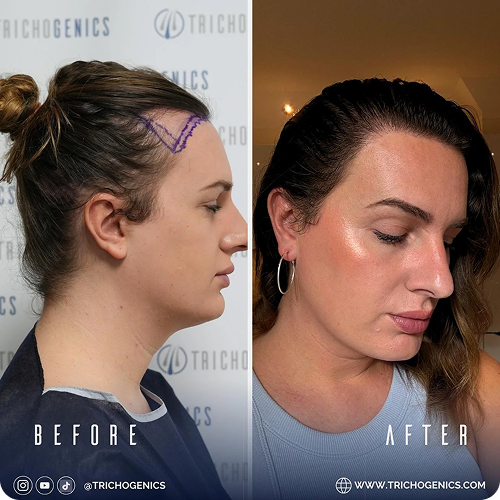

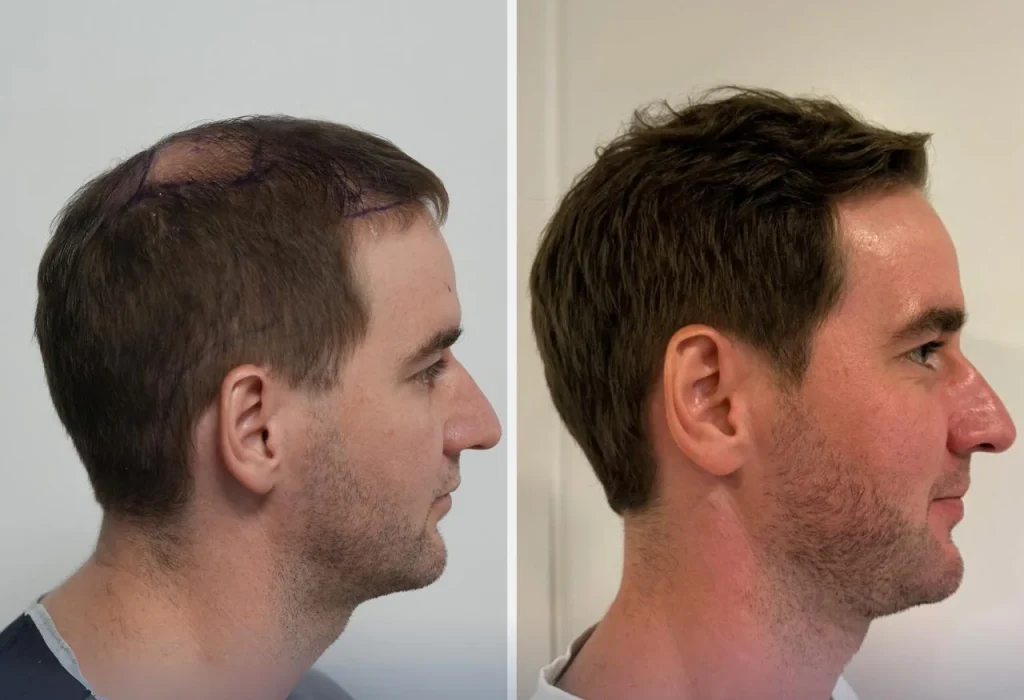
The crown usually trails the hairline. Month five is a steady middle stage, and most of the visible thickening comes between months 6 and 12.
Knowing what is normal now helps you judge your progress realistically.
Key Takeaways
- A hair transplant after 5 months usually shows early regrowth, but density and coverage are incomplete because follicles are still maturing.
- A thin or uneven look at this stage is common and does not predict the final result. Follicles start producing at different times.
- The crown often develops more slowly than the hairline, with clearer improvement several months later.
- Most gains in thickness happen between months 6 and 12, so patience and steady follow-up matter.
Hair Transplant Results at 5 Months
What Does 5 Months of Hair Growth Look Like?
Most patients see early regrowth across the transplanted areas, though coverage is still incomplete. New strands are usually thin, soft, and uneven in length.
Many people compare the look to light stubble rather than full density. That is not the final result, because the follicles are still settling in.
Shafts that appear now are often immature. They thicken as growth cycles continue, which is why length shows up before visible coverage does.
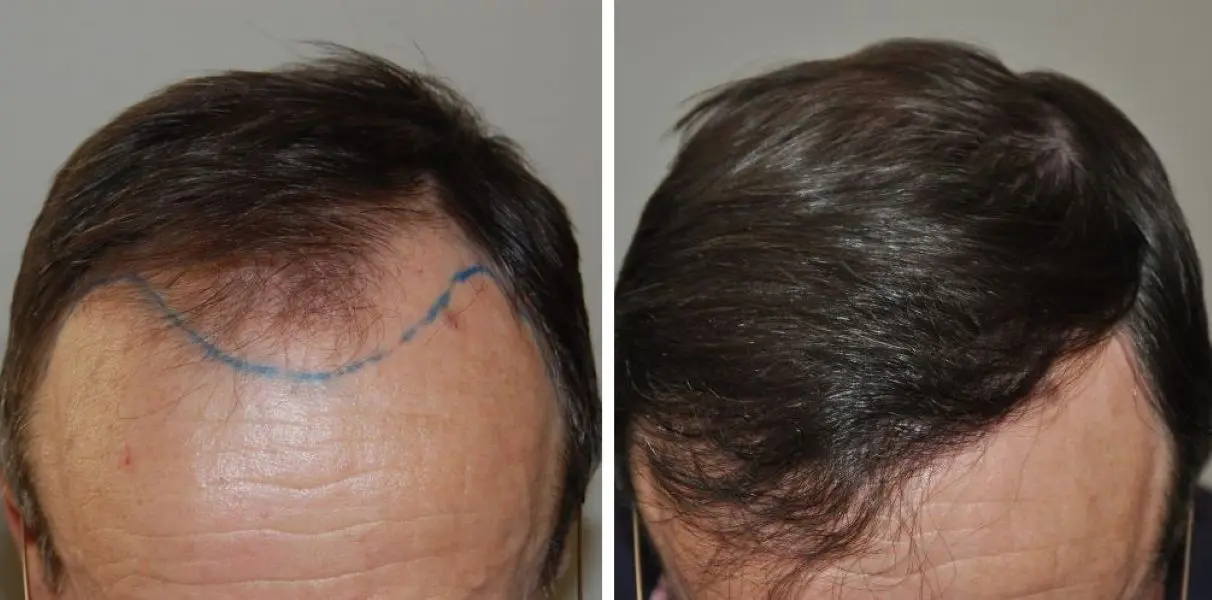
5 Months After Hair Transplant Pictures
Photos taken 5 months after hair transplant surgery can look very different from one patient to the next. Age, hair-loss pattern, donor quality, and technique all change the outcome.
Uneven density is common in photos, especially across larger recipient areas. That variation is expected and does not mean the procedure failed.
Comparing your photos with a hair transplant after 4 months usually shows small but real gains in coverage and strength. Our post on 4 months after a hair transplant is a good reference point.
How Month 5 Fits the Overall Timeline
Hair transplant month 5 sits in the middle of the month-by-month results timeline. Here is how hair transplant progress usually unfolds:
- Months 1 to 3: shedding and shock loss are common while follicles rest.
- Months 3 to 4: visible growth usually begins.
- Month 5: early stabilization. Fine strands are lengthening but not yet thick.
- Months 6 to 12: thickness and coverage improve the most.
Reviewing a structured hair transplant recovery timeline explains why results keep changing well beyond this stage.
@trichogenics Everyone is different when it comes to rate of growth of newly transplanted hair. This patient of ours did exceptionally well in a really short time. We expect to see further improvement in the coming months. #trichogenics #hairtransplantturkey #hairtransplant #hairloss
♬ original sound - Trichogenics
Why Hair Looks Thin at Month 5
Hair transplant results become visible months after surgery, and the first stretch of regrowth almost never looks full. Follicles restart on their own schedules, so some are producing while others still rest.
5 Months After Hair Transplant: No Density
Low density at this point is one of the most common worries patients report, and it is usually normal. Follicles do not grow at the same speed or start at the same stage.
Some are still dormant while others already produce shafts. That staggered start creates a patchy look across the treated area.
Density also depends on how many follicles survive and how they mature. Coverage can look lighter than you expected.
Normal Growth vs Slow Progress
Not every patient grows at the same rate. These factors shape progress:
- Extent of prior hair loss
- Donor area quality
- Individual healing process
- Surgical technique and placement
Slow progress does not mean a poor outcome. Follicles that look inactive at month five often start producing in later cycles.
5 Months Post Hair Transplant: Growth and Healing
How Long Does Hair Grow in 5 Months
Hair growth in 5 months is gradual. New strands are roughly half an inch to an inch long, since most visible growth began around months three to four. Speed varies, and you will notice lengthening before you notice volume.
Growth follows cycles, so length and thickness improve at different paces. Uneven growth across the recipient area is common and reflects normal biology, not a surgical problem.
What’s Happening Under the Scalp
Beneath the surface, follicles are finishing early growth cycles and settling into more stable phases. Healing continues at a microscopic level even when the scalp looks calm.
Blood supply around the transplanted area has strengthened, which supports long-term follicle health.
The donor area is usually fully healed by now. Mild sensitivity or tightness can linger, but it typically fades.
Crown Results at 5 Months
Why Crown Growth Is Slower
The crown often improves more slowly than the hairline. Blood flow patterns and the swirl of hair direction make crown restoration more demanding, so surgeons usually expect density to take longer here.
This is common in crown hair transplant procedures and does not suggest poor graft survival.
How Long Does a Crown Hair Transplant Take to Grow?
Expect early thickening after month five, clearer improvement between months six and nine, and continued maturing close to the 12-month mark.
A crown hair transplant 6 months out usually looks noticeably thicker than it does at month five. Some crowns keep improving beyond month 12.
Crown Hair Transplant Month by Month
- Month 3: shedding is winding down, and the crown often still looks bare.
- Month 4: the first fine strands appear in some spots.
- Month 5: growth is thin and patchy, and the crown lags behind the hairline.
- Month 6: shafts begin to thicken, and coverage improves.
- Months 7 to 9: visible density builds.
- Months 9 to 12: results approach their final look.
Patience matters most with crown-focused procedures. Judging the result at month five often causes unnecessary worry.
What to Do After Month 5
Hair Care and Daily Habits
By now, most patients can return to normal grooming. Gentle washing and standard products are fine unless your surgeon says otherwise. Keep protecting your scalp from the sun.
Helpful habits include:
- Avoid aggressive scratching
- Maintain consistent scalp hygiene
- Follow medical advice for any ongoing treatments
These steps support long-term recovery.
@trichogenics You got a hair transplant… now what? Here are some recommendations for your hair transplant recovery and aftercare. #hairtransplant #hairtransplantturkey #balding #malepatternbaldness #finasteride #minoxidil #hairtransplantresult #hairloss #trichogenics #hairtransplantmexico
♬ original sound - Trichogenics
When to Follow Up With Your Surgeon
Structured follow-up is part of responsible surgical care. A review around this stage lets your surgeon assess progress and reset expectations. It also catches problems early, though complications are uncommon at this point.
Clinics that emphasize physician-led care and consistent monitoring tend to give clearer guidance during recovery. That is one reason many patients choose regulated medical settings, such as those in Greece and Israel, where standards and oversight are well defined.
In some countries abroad, including Turkey, much of the procedure is often handled by technicians rather than physicians. That can raise variability in care and follow-up.
Key Clinical Context and Techniques
Modern restoration relies on established methods such as FUE, DHI, and Choi pen implantation. At Trichogenics, procedures use only FUE and DHI, and we do not perform FUT.
Understanding how FUE hair transplant methods work explains why an FUE hair transplant 5 months in still looks unfinished and improves gradually.
These approaches focus on precise follicle placement and controlled depth in recipient areas. Doctor-led procedures keep medical accountability in place throughout the timeline.
Key elements often discussed in clinical settings include:
- Physician training and certification
- Proper handling of follicles
- Planned implantation angles
- Structured patient follow-up
These factors shape long-term outcomes more than short-term appearance.
What to Expect Moving Forward
At five months, results are still in progress. Density, texture, and coverage keep improving well beyond this stage.
6 Months After Hair Transplant
Hair transplant results after 6 months show more noticeable growth and the first real density gains. Wispy strands from month five begin to thicken, and the hairline usually looks fuller than the crown.
Most of the visible change in thickness happens between months 6 and 12, with final results settling later.
Many patients ask whether results last. Reviewing whether hair transplants are permanent clarifies what to expect as follicles mature.
Why Choose Trichogenics?

All procedures are performed only by doctors
Trichogenics runs a strict medical process. Only certified doctors perform every transplant. No technicians or unqualified assistants are involved.
Choosing a clinic with proven experience makes a real difference.
Meet Dr. Asi and Dr. Eric Peretz
Care is led by Dr. Asi I. Peretz and Dr. Eric Peretz, both ABHRS Diplomates and Fellows of the World FUE Institute, a small group of hair restoration surgeons worldwide.
Their experience, attention to detail, and focus on natural results set Trichogenics apart.
[Image: insert one photo of the team, Dr. Asi, or Dr. Eric here.]
Celebrity Hair Transplants
Who has had a procedure at Trichogenics? Patients come for natural results that hold up in person and under camera lights.
Contact Trichogenics today to schedule a personal consultation and get a clear, doctor-led plan for your hair restoration.